Trying Harder to Stand Tall Is Making Your Pain Worse — Here's What Your Body Actually Needs
Somewhere along the way, most of us got the same advice: chin up, shoulders back, stop slouching. It sounds reasonable. It even feels virtuous in the moment — like you're doing something proactive about the neck ache that's been nagging you since that last long Zoom call.
But here's the thing. For a lot of people, that constant effort to hold themselves "correctly" is quietly making things worse.
It's not laziness. It's not bad posture genetics. It's something much more interesting — and once you understand it, the whole way you think about your body changes.
Your Nervous System Doesn't Know the Difference Between a Tiger and a Tight Deadline
When your brain perceives a threat — whether that's a stressful meeting, a painful movement, or even the mental effort of trying to hold a position your body hasn't learned to trust — it activates a protective response. Muscles tighten. Breathing gets shallower. The whole system goes into a kind of guarded mode.
Here's where posture gets complicated: when you consciously force your spine into a position it isn't used to, your nervous system can register that effort as a low-level stressor. The muscles around your spine, hips, and shoulders don't just respond to physical signals — they respond to perceived threat. And "holding yourself together" all day can feel, neurologically speaking, a lot like bracing for impact.
Researchers studying pain neuroscience have started calling this the postural paradox — the harder you try to control how you hold your body, the more tension you accumulate, and the more sensitive your pain signals become. You end up working against yourself without even realizing it.
The Problem With Correction-Based Thinking
Traditional postural advice operates on a mechanical model: your body is like a building, and if the structure is misaligned, you fix it by adjusting the load-bearing walls. Stand straighter. Tuck your pelvis. Don't let your head jut forward.
That model isn't entirely wrong, but it misses something crucial — your body isn't a building. It's a living, sensing, constantly adapting system. And systems that are stressed don't reorganize well under pressure. They brace.
Think about the last time you were really anxious. Did your posture naturally open up? Or did your shoulders creep toward your ears and your jaw quietly clench? Stress and tension express themselves through the body's shape. Which means you can't sustainably change the shape without addressing the tension driving it.
This is exactly where the intersection of sound therapy and massage bodywork starts to get genuinely fascinating.
What Sound Does That Willpower Can't
At Healing Melody Massage, the approach to postural tension isn't about telling your body where to go — it's about creating the conditions where your body actually wants to shift.
Sound frequencies — particularly the low, resonant tones used in therapeutic settings — have a documented effect on the autonomic nervous system. Certain vibrations help dial down sympathetic activation (the fight-or-flight side of things) and nudge the body toward parasympathetic rest. When that happens, muscles that have been holding on for dear life start to soften — not because they were forced to, but because the threat signal quieted down.
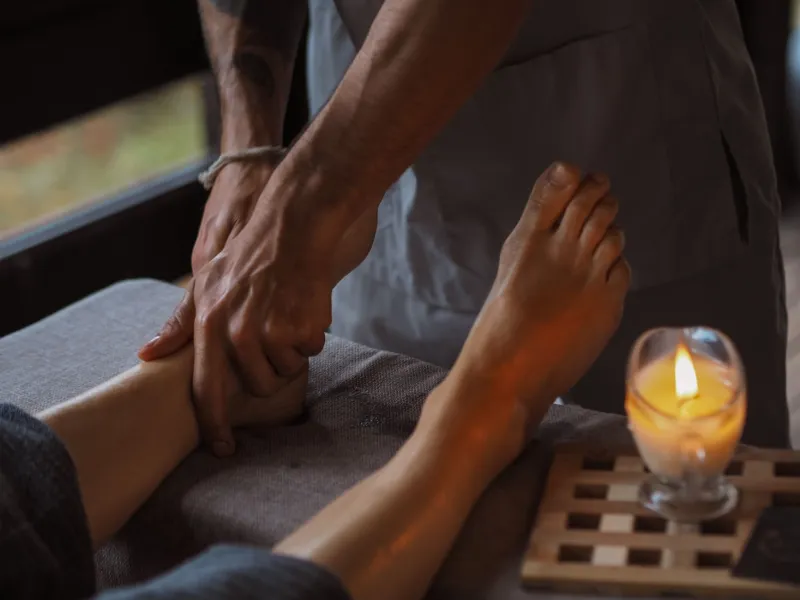
Pair that with skilled massage work, and something different becomes possible. A therapist working with the body's natural movement patterns — rather than pushing it into an "ideal" position — can help release the deep holding patterns that have built up over years of chronic stress, long commutes, desk work, and yes, all that misguided "sit up straight" effort.
The combination matters. Sound alone can shift your nervous system state. Touch alone can address tissue tension. But when they work together, you get a window where the body is both neurologically calm and physically accessible — and that's when real reorganization can happen.
Natural Movement Over Rigid Alignment
One of the more liberating ideas coming out of modern movement science is that there isn't one correct posture. There's a range of healthy movement, and the body does best when it can flow through that range rather than park itself at one fixed point all day.
Your spine is designed to move — to flex, extend, rotate, and adapt. The problem isn't usually that people are stuck in the wrong position. It's that they're stuck, period. Chronic tension locks the body into limited patterns, and no amount of conscious correction addresses the underlying stiffness driving those patterns.
After a sound-guided massage session, clients often notice something unexpected: they're not sitting differently because they're trying to. They're sitting differently because it suddenly feels more natural to do so. The effort is gone. The body has reorganized around a lower tension baseline, and better alignment follows almost automatically.
That's a fundamentally different experience from gripping your shoulder blades together and counting the minutes until you can relax again.
Breaking the Cycle in Real Life
If you've been dealing with chronic neck pain, upper back tightness, or that low-grade ache that seems to live between your shoulder blades, there are a few things worth reconsidering.
First, notice whether your postural "fixes" are creating more holding. If correcting yourself feels like effort — if you have to grip or brace or remind yourself constantly — that's a sign the approach isn't sustainable. Sustainable change feels like relief, not discipline.
Second, consider that your pain might have less to do with the angle of your spine and more to do with the state of your nervous system. Chronic stress keeps the body in a guarded posture because that's what stressed bodies do. Addressing the stress state, not just the symptom, changes the equation.
Third, give your body experiences of ease, not just correction. Therapeutic environments that combine calming sound with skilled touch aren't a luxury — they're actually one of the more direct ways to interrupt a nervous system that's been running hot for too long.
Your Body Wants to Find Its Own Balance
Here's the thing about the body that tends to get lost in all the posture-correcting advice: it's remarkably good at self-organizing when the conditions are right. Given enough safety, enough ease, and enough skilled support, it tends to move toward less pain and more functional movement — not because it was forced there, but because that's where it naturally wants to go.
The work of sound-guided massage isn't about imposing a new shape on your body. It's about removing the obstacles — the accumulated tension, the nervous system noise, the habitual bracing — that are keeping your body from finding its own equilibrium.
Standing taller doesn't start with trying harder. It starts with letting go.
And that's a much more interesting place to begin.